

corrosion-resistant materials for Seawater Desalination Equipment
Seawater Desalination equipment operates in one of the more demanding environments for industrial materials. High chloride concentration, dissolved oxygen, moisture, pressure, temperature changes, and chemical exposure can all contribute to corrosion.
For seawater reverse osmosis (SWRO) systems, material selection is therefore not simply a matter of choosing a material with high mechanical strength. The material also needs to tolerate prolonged contact with seawater, concentrated brine, cleaning chemicals, and the operating conditions of individual components.
A high-pressure pump, RO pressure vessel, seawater intake pipe, valve, fitting, support structure, and chemical dosing line may all require different material considerations.
Choosing corrosion-resistant materials at the design stage can reduce maintenance requirements, leakage risks, unplanned shutdowns, and premature component replacement. The appropriate choice depends on seawater chemistry, pressure, temperature, flow velocity, component function, fabrication method, and project requirements.
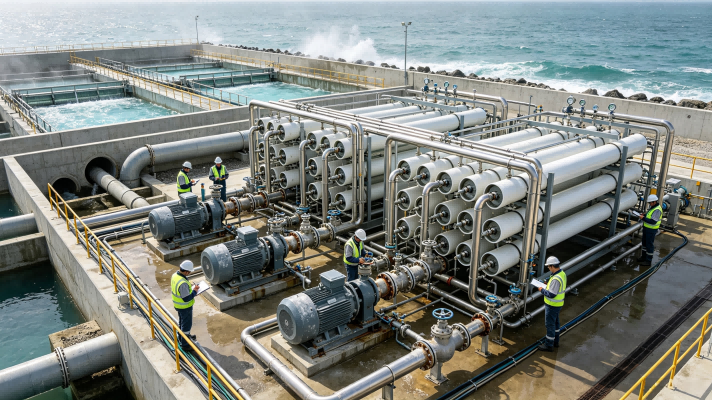
Seawater contains a significant concentration of chloride ions. Chlorides can attack susceptible metallic surfaces and contribute to localized corrosion, including pitting and crevice corrosion.
The problem becomes more complicated in desalination systems because seawater is not maintained at the same concentration throughout the entire process.
At the RO feed side, the equipment handles seawater under high pressure. Inside the membrane system, water is removed and the remaining concentrate becomes increasingly saline.
The concentrate stream can therefore create a different corrosion environment from the original feedwater.
In addition, desalination plants may use chemicals for pretreatment, antiscalant dosing, pH adjustment, membrane cleaning, disinfection, and other process operations.
A material that performs well in one section of the plant may not be appropriate in another.
This is why corrosion-resistant material selection should be based on the actual service conditions of each component rather than treating the entire desalination plant as a single material environment.
Understanding the type of corrosion helps engineers determine which materials and design practices are appropriate.
Pitting corrosion is a localized form of corrosion that creates small cavities in a metal surface.
Chloride-containing seawater can increase the risk of pitting in susceptible stainless steels, particularly when conditions promote breakdown of the passive surface layer.
Although a pit may initially appear small, continued penetration can eventually compromise a pipe, fitting, valve, or other pressure-containing component.
Crevice corrosion can occur in narrow areas where seawater becomes stagnant or oxygen concentration differs from the surrounding solution.
Typical locations include:
Flange connections
Gaskets
Bolted joints
Valve components
Pipe supports
Overlapping surfaces
Good equipment design should therefore minimize unnecessary crevices and stagnant zones.
Galvanic corrosion can occur when dissimilar metals are electrically connected while exposed to an electrolyte such as seawater.
If incompatible metals are combined without appropriate isolation, one material may become the preferential site of corrosion.
Material compatibility therefore needs to be considered not only for individual components but also for complete piping assemblies.
High flow velocity can accelerate the removal of protective surface films and increase corrosion rates.
Areas around elbows, reducers, valves, pump outlets, and other locations with high turbulence may be particularly important.
Material selection and hydraulic design should therefore be considered together.
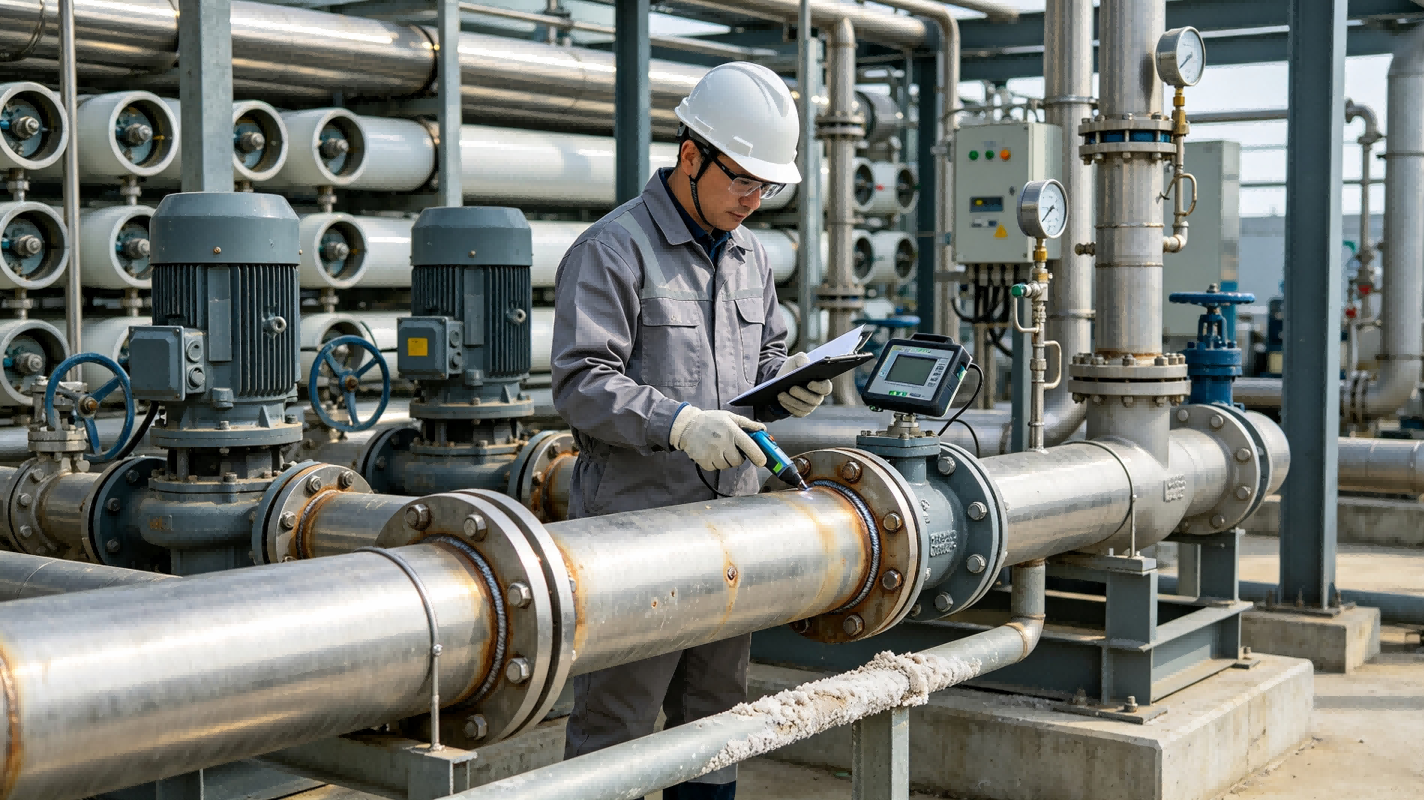
Stainless steel is widely used in industrial water treatment because it combines mechanical strength, corrosion resistance, availability, and fabrication practicality.
However, “stainless steel” is a broad material category.
Different stainless steel grades have significantly different resistance to chloride-containing environments.
Common applications can include:
Equipment frames
Piping
Tanks
Valves
Fittings
Instrument connections
Pump components
The appropriate grade depends on the actual seawater exposure and operating conditions.
For relatively mild service conditions, a conventional stainless steel grade may be suitable for selected components.
For direct seawater service, engineers often consider grades with greater resistance to localized chloride corrosion.
Material selection should always be checked against the component manufacturer's specifications and the actual process conditions.
Duplex stainless steels combine characteristics of austenitic and ferritic stainless steels.
They generally provide higher strength than many conventional austenitic stainless steels while offering improved resistance to chloride-related corrosion in appropriate applications.
This combination can make duplex stainless steel attractive for seawater desalination equipment where both mechanical strength and corrosion resistance are important.
Potential applications include:
Seawater piping
Pumps
Valves
Pressure components
Heat exchanger components
Structural equipment
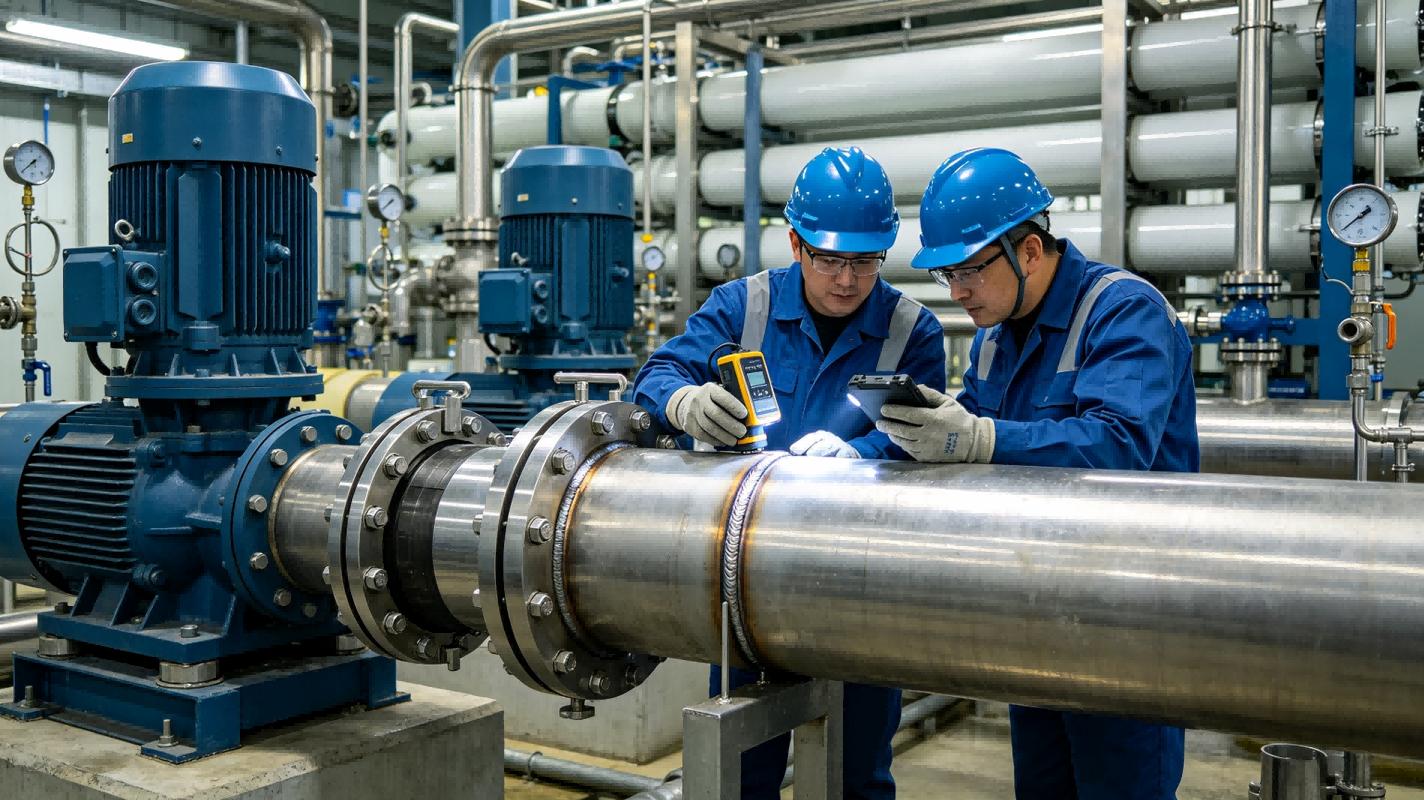
However, duplex stainless steel requires appropriate fabrication, welding, heat treatment, and quality control.
Poor welding practices can affect the microstructure and corrosion resistance of the finished component.
Super duplex stainless steels are designed for demanding chloride-containing environments and provide a higher level of corrosion resistance than many standard stainless steel and duplex grades.
They are often considered for critical seawater-service components where exposure conditions are particularly demanding.
Examples may include:
High-pressure seawater piping
Pump components
Valves
Fittings
Seawater manifolds
Other critical wetted components
The material itself is only part of the equation.
Welding procedures, filler materials, heat input, surface condition, passivation where applicable, and fabrication quality can all influence the final corrosion performance.
For this reason, material certificates and fabrication quality should be considered alongside the nominal material grade.
Titanium has excellent resistance to seawater corrosion and is used in applications where long-term corrosion resistance is particularly important.
Its resistance is associated with the stable protective oxide film that forms on the surface.
Titanium can be used in selected heat exchanger components, piping, fittings, and other seawater-contact applications.
Its relatively high material and fabrication cost means it is not automatically the best choice for every component.
Instead, engineers generally consider titanium when the operating environment, expected service life, maintenance requirements, and project economics justify its use.
Fiber-reinforced plastic (FRP) is another important material group in desalination plants.
FRP combines a polymer matrix with reinforcing fibers, providing corrosion resistance together with relatively low weight.
Depending on the resin and reinforcement system, FRP can be suitable for certain seawater intake, pretreatment, filtration, and chemical service applications.
Potential advantages include:
Resistance to many corrosive environments
Low weight
Reduced risk of metal corrosion
Flexible fabrication options
Relatively low maintenance requirements
However, FRP is not universally suitable for every application.
Mechanical strength, temperature resistance, pressure rating, UV exposure, chemical compatibility, joint design, and installation conditions all need to be considered.
Selected engineering plastics can also be used in seawater desalination equipment.
Materials such as PVC, CPVC, PP, PE, PVDF, and other specialized polymers may be considered for particular piping, valves, filter housings, chemical dosing systems, and low- or moderate-pressure applications.
Their suitability depends strongly on temperature, chemical exposure, pressure, and mechanical loading.
For example, a polymer that performs well in a chemical dosing line may not be suitable for a high-pressure seawater line.
The operating pressure and temperature should therefore be checked before selecting a plastic material.
The high-pressure section of an SWRO system requires particular attention.
Feedwater is pressurized to overcome the osmotic pressure of seawater and drive water through the RO membranes.
This means high-pressure pumps, piping, valves, fittings, manifolds, and connections must withstand both mechanical and corrosion loads.
Material selection for these components should consider:
Operating pressure
Design pressure
Seawater salinity
Chloride concentration
Flow velocity
Temperature
Chemical exposure
Fatigue conditions
Welding requirements
Maintenance access
The highest-cost material is not necessarily required for every component.
A more practical design uses materials according to the actual service conditions and risk level of each part.
RO pressure vessels are generally designed with a strong emphasis on pressure containment and long-term reliability.
Depending on the system configuration, pressure vessels may use composite materials or other engineered constructions suitable for high-pressure membrane operation.
The internal membrane elements are also designed specifically for the chemical and hydraulic conditions of reverse osmosis.
While the membrane itself is the primary separation component, the surrounding pressure vessel, end connections, permeate tubes, brine seals, adapters, and fittings also need to be compatible with the operating environment.
A mismatch between component materials can create maintenance problems even when the membrane elements themselves are functioning correctly.
Piping material should be selected according to both the fluid and the pressure level.
The intake side may handle raw seawater containing suspended solids and biological material.
The RO feed line handles pressurized seawater.
The concentrate line handles water with a higher salt concentration.
The permeate line handles treated water with substantially lower salinity.
These streams do not necessarily require identical materials.
Engineers should evaluate:
Fluid composition
Pressure
Temperature
Flow velocity
Pipe diameter
Connection method
External environment
Chemical exposure
Expected service life
Correct material selection can also reduce the need for frequent coating repair or corrosion-related replacement.
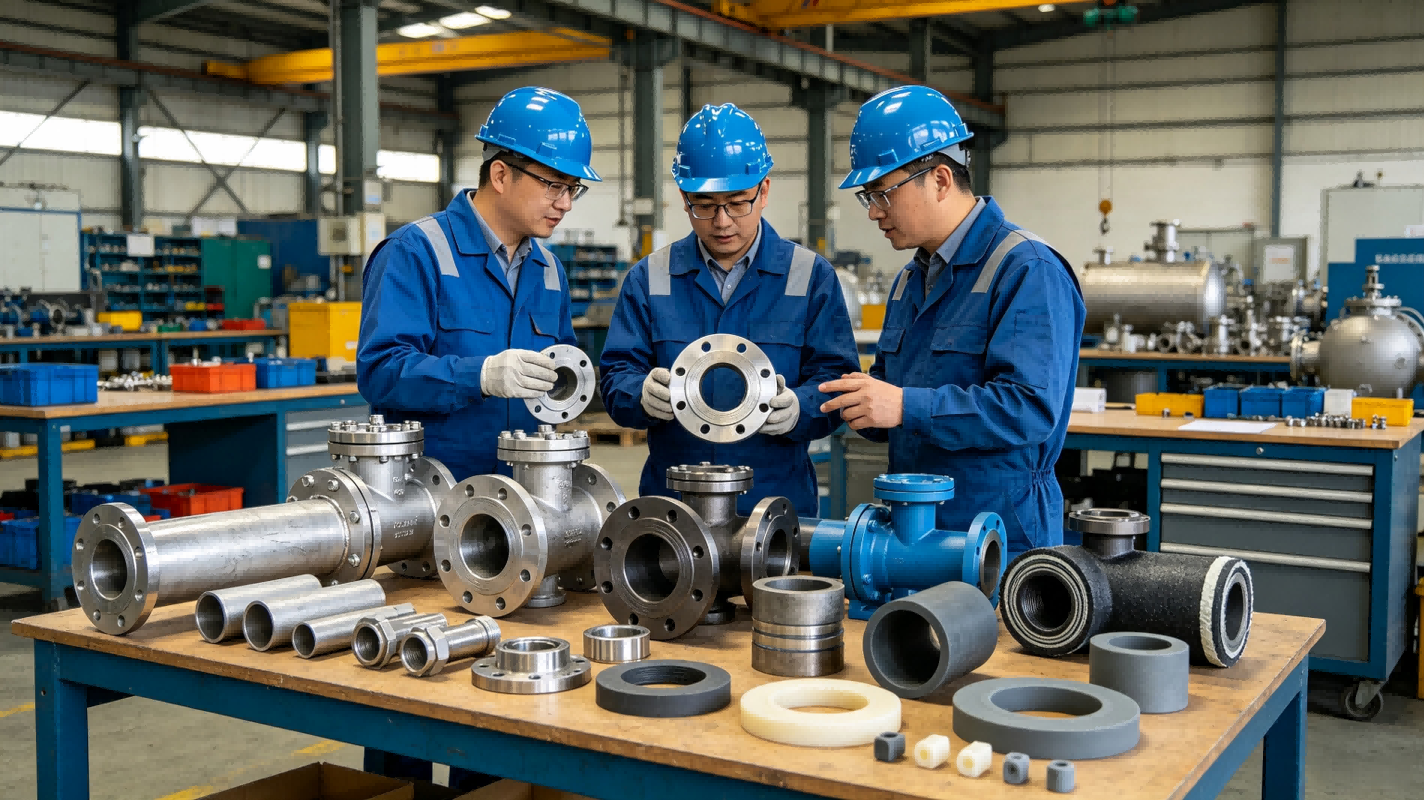
Valves and fittings are often smaller than major process equipment, but they can become important corrosion points.
Valve bodies, stems, seats, bolts, fasteners, flanges, gaskets, and internal components may all be exposed to different conditions.
A valve installed directly in seawater service should therefore be selected according to the same corrosion and pressure considerations applied to the main piping.
The material of the valve body alone is not enough.
Internal wetted components and fasteners should also be checked for compatibility.
Selecting a corrosion-resistant material does not guarantee corrosion-free operation.
Fabrication quality has a major influence on actual service performance.
Welding can change the local microstructure of stainless steels and duplex materials. Heat input, shielding, welding procedure, filler selection, and post-weld treatment may affect corrosion resistance.
After fabrication, appropriate cleaning and surface treatment may also be required.
For critical seawater-service components, manufacturers and project teams may specify inspection and testing procedures such as:
Visual inspection
Dimensional inspection
Weld inspection
Pressure testing
Material verification
Surface inspection
Documentation review
The exact inspection requirements depend on the component and project specification.
A material's corrosion resistance can be affected by its surface condition.
Contamination from carbon steel tools, grinding particles, improper handling, or fabrication residues can create local corrosion risks on stainless steel surfaces.
For equipment exposed to seawater, clean fabrication practices are therefore important.
Surfaces should be protected from unnecessary contamination during manufacturing, transportation, installation, and maintenance.
Where required, cleaning, passivation, or other surface treatment should be carried out according to the applicable material and project requirements.
Material selection is one layer of corrosion protection, but equipment design also plays a major role.
Good design can reduce corrosion risk by:
Avoiding stagnant zones
Minimizing unnecessary crevices
Controlling flow velocity
Selecting compatible materials
Isolating dissimilar metals
Providing drainage
Protecting equipment from external moisture
Allowing access for inspection
In some applications, coatings, linings, cathodic protection, or sacrificial components may also be considered.
The appropriate strategy depends on the equipment and operating environment.
One important consideration in SWRO systems is that the water chemistry changes as the process progresses.
At the concentrate outlet, dissolved salts are more concentrated than in the feedwater.
This can increase the chemical stress on certain components.
The concentrate piping, valves, fittings, and discharge system should therefore be evaluated separately from components handling the original seawater.
Similarly, areas where water can evaporate or become stagnant may experience local changes in concentration that increase corrosion risk.
Understanding the actual process path is therefore essential for material selection.
SWRO membranes are periodically cleaned using chemical solutions when fouling or scaling causes significant performance deterioration.
The cleaning chemicals can expose equipment to conditions that are different from normal seawater operation.
CIP systems therefore require their own material compatibility assessment.
Components such as:
CIP tanks
Cleaning pumps
Chemical dosing lines
Valves
Hoses
Filters
Instrument connections
should be compatible with the cleaning chemicals at the specified concentration, temperature, and exposure time.
A material suitable for seawater may not necessarily be suitable for every cleaning solution.
Material selection always involves more than corrosion resistance alone.
Engineers also need to consider:
Initial material cost
Fabrication cost
Welding requirements
Availability
Lead time
Installation cost
Maintenance requirements
Expected service life
Replacement difficulty
Using a premium material throughout the entire plant can significantly increase project cost without necessarily providing proportional benefits.
On the other hand, selecting a material with insufficient corrosion resistance can result in leaks, maintenance shutdowns, and premature replacement.
A practical design therefore matches material performance with the actual service conditions of each component.
Even corrosion-resistant equipment requires inspection.
Regular inspections can identify early signs of:
Surface discoloration
Pitting
Crevice corrosion
Leaks
Joint deterioration
Coating damage
Fastener corrosion
Unusual deposits
Particular attention should be given to flanges, valve connections, pipe supports, weld areas, pump components, and locations where seawater may remain trapped.
Inspection records can help operators identify recurring problems and determine whether material selection, process conditions, or equipment design needs to be reviewed.
There is no single material that is ideal for every part of a Seawater Desalination Plant.
A simplified engineering approach might look at the system in sections:
Seawater intake:
Materials need to tolerate continuous seawater exposure, biological activity, suspended solids, and the external marine environment.
Pretreatment:
Material selection depends on filtration processes, chemical dosing, pressure, and water chemistry.
High-pressure SWRO section:
Pressure resistance and chloride corrosion resistance become particularly important.
RO concentrate section:
Higher salinity and potentially aggressive water chemistry require careful evaluation.
Permeate section:
The treated water has different chemistry from seawater, so material requirements may differ.
CIP system:
Chemical compatibility becomes a major consideration.
This component-by-component approach is generally more useful than selecting one material for the entire installation.
Customized seawater desalination equipment often requires material selection to be integrated with the overall process design.
The equipment manufacturer needs to understand the seawater source, flow rate, salinity, temperature, required production capacity, operating pressure, recovery, pretreatment configuration, chemical dosing, and installation environment.
For example, a compact containerized SWRO system installed near the coast may have different material and external protection requirements from a large permanent desalination plant.
Similarly, an offshore platform, vessel, island resort, industrial facility, and municipal desalination project may all require different material combinations.
A suitable material strategy should therefore be developed together with the equipment design rather than selected after the main system has already been fabricated.
Corrosion is a long-term engineering consideration in seawater desalination equipment.
Chloride-rich seawater, concentrated brine, high pressure, flow velocity, temperature, cleaning chemicals, and fabrication conditions can all influence the service life of equipment.
Stainless steel, duplex stainless steel, super duplex stainless steel, titanium, FRP, and engineering plastics each have their own advantages and limitations.
The right choice depends on where the material is used and what conditions it will face.
For SWRO systems, particular attention should be given to high-pressure pumps, seawater piping, valves, fittings, pressure vessels, concentrate lines, CIP equipment, and connections between dissimilar materials.
Good corrosion control combines appropriate material selection with sound hydraulic design, proper fabrication, compatible chemical operation, surface protection, and regular inspection.
For seawater desalination equipment manufacturers and project engineers, evaluating these factors at the design stage can help create systems that are easier to maintain and better suited to long-term operation in demanding marine environments.
ເວັບໄຊທ໌ນີ້ໃຊ້ cookies ເພື່ອຮັບປະກັນວ່າທ່ານໄດ້ຮັບປະສົບການທີ່ດີທີ່ສຸດໃນເວັບໄຊທ໌ຂອງພວກເຮົາ.
 English
 Portugues
 Pусский
 Français
 العربية
 ไทย
ไทย Indonesia
 Melayu
 Tiếng Việt
 中文
中文 қазақ
қазақ עִברִית
 မြန်မာ
 Filipino
 o'zbek
 Кыргызча
 тоҷикӣ
 ខ្មែរ
ខ្មែរ Türkmenler



 ໂທລະສັບ
ຄໍາເຫັນ
(0)